

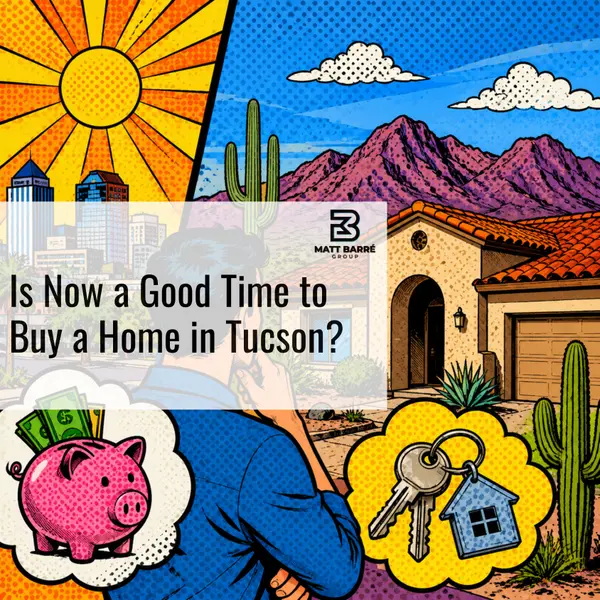
"Is It a Good Time to Buy?" Here's Tucson's Actual Answer.
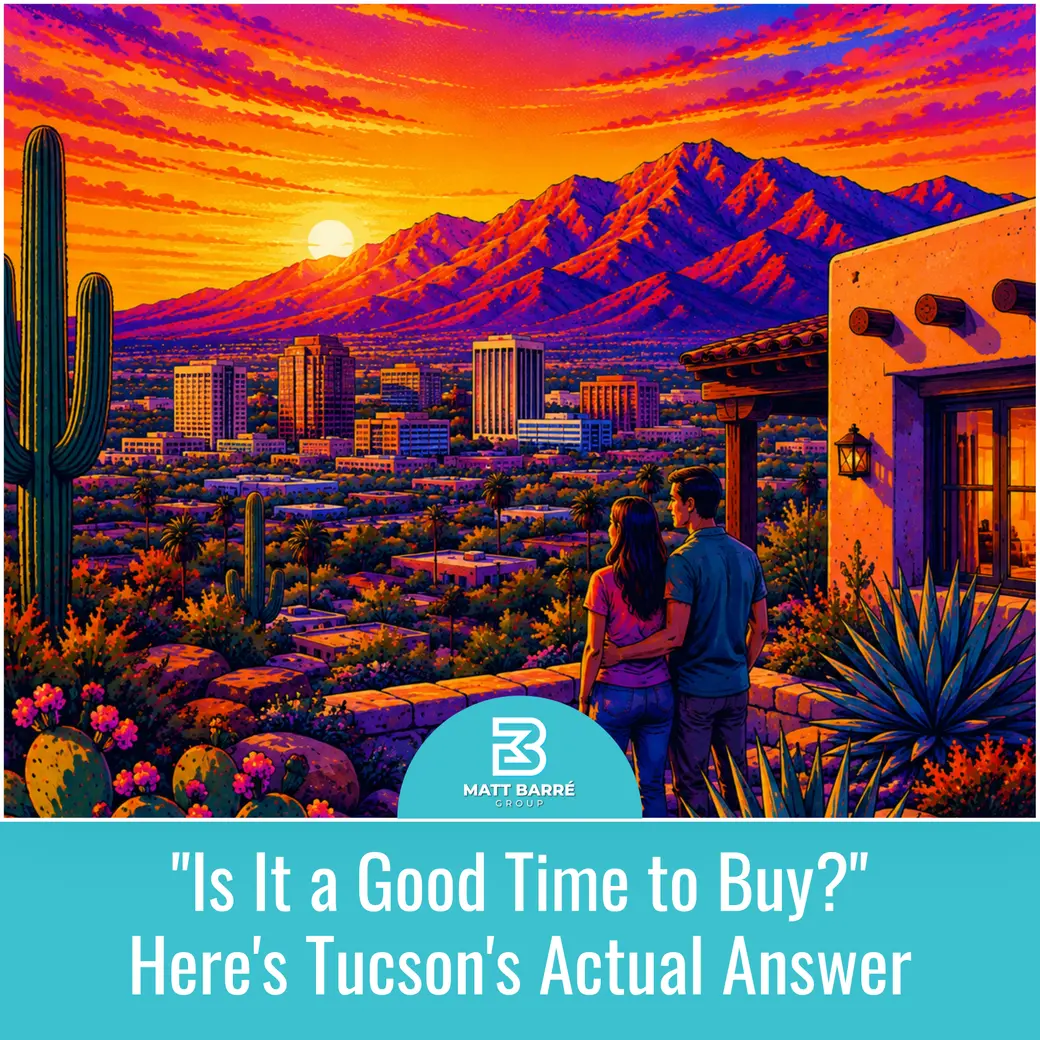
"Is It a Good Time to Buy?" Here's Tucson's Actual Answer
“Is it a good time to buy?” It's the single most-Googled real estate question in the entire country right now, more than "how much house can I afford," more than "best mortgage rates," more than anything else people are typing at 11pm while doom-scrolling Zillow in bed. And I get it. Rates went up again this week, we're sitting around 6.77% to 6.9% on a 30-year fixed, the highest they've been in over a year, and every headline seems to have a different opinion about what that means for you.
So I want to answer it. Not with a vague "it depends" (even though, annoyingly, it kind of does), but with actual numbers, actual context, and what I'm seeing on the ground here in Tucson every single week.
Why This Question Is Suddenly Everywhere
Here's the thing about "is it a good time to buy" spiking as a search term: it's not really a question about the market. It's a question about fear. Buyers are watching rates climb back toward 7%, they're hearing conflicting predictions from every finance influencer with a ring light, and they're paralyzed trying to time something that (I'll just say it) cannot be timed. Nobody, and I mean nobody, has ever consistently called the bottom of a housing market. Not economists. Not Wall Street. Not your uncle who "saw the '08 crash coming."
There's No Such Thing as a Perfect Time, There's Only Your Time
I know that sounds like a bumper sticker. But stay with me. The "perfect time" to buy would require rates to be low, prices to be low, inventory to be high, and competition to be nonexistent, all at once. That moment doesn't exist. It never has. When rates were 3%, prices were exploding and you were competing against fifteen other offers with the seller's cat as a witness. When prices dip, it's usually because something in the broader economy is making buyers nervous enough to stay home. The market doesn't hand out gifts. It hands out trade-offs. Your job isn't to find the mythical perfect moment, it's to figure out which trade-off you can actually live with.
What's Actually Happening in Tucson Right Now
Okay, numbers time. As of this week, the median sale price in Tucson sits right around $357,500, basically 0% year-over-year. Homes are taking about 78 days to sell, up from last year, and we're sitting on roughly a 4-month supply of inventory. Translation: this is a balanced market, not a feeding frenzy, not a fire sale. Sellers are pricing more realistically — nearly half of active listings have taken a price cut at some point and properties are closing around 95.4% of asking price instead of the 105%-plus bidding wars we saw a few years back.
That balance is the headline. You're not walking into a stampede. You're also not walking into a market that's about to hand you a home for pennies on the dollar. Forecasts have Tucson appreciating somewhere in the 2% to 4% range this year, and this is the part I think gets buried. Incomes are actually rising faster than home prices for the first time since the Great Recession. That's a quiet, unglamorous trend, but it's the one that actually moves the needle on affordability over time.
The Math Buyers Keep Skipping
Here's where I want you to slow down for a second, because this is the part that gets lost in all the rate-headline noise. Say rates drop a full percentage point over the next year, a genuinely optimistic scenario. Great news for your payment, right? Except when rates drop, more buyers come off the sidelines at the same time, inventory tightens back up, and prices climb in response. You might save on the interest rate and lose it right back on the purchase price. Meanwhile, the buyers who bought at today's rate get to do something the rate-watchers don't: refinance later if the number ever comes down. You can always refinance a rate. You can't refinance your way into a house you never bought.
And Tucson's relative affordability still matters here more than people give it credit for. Buyers relocating from California, Colorado, or the Pacific Northwest routinely tell me the same thing, the budget that got them a two-bedroom condo somewhere else gets them a single-family home with a yard in Tucson, Oro Valley, Vail, or Marana. That gap hasn't closed. It's part of why Tucson keeps showing up on national relocation lists year after year, sunshine aside.
What Leverage Actually Looks Like Right Now
This is the part buyers underestimate the most. It's not just that inventory is up, it's what that inventory does to seller behavior. A house that would've sold in a weekend three years ago might now sit for two and a half months. That changes the entire tone of a negotiation. I've had sellers cover closing costs to keep a deal moving. I've had sellers agree to buy down a buyer's rate for the first couple of years instead of dropping the price, which can be the smarter move depending on how long you plan to stay. I've had inspection items that would've been laughed off the table in 2022 get fixed without a fight. None of that is guaranteed on every house, some sellers are still firm, especially in the more competitive price bands, but the leverage is real, and most buyers walking in cold don't know how much of it is on the table until someone points it out.
That's really the whole game right now. It's not about outsmarting the market. It's about knowing which levers exist and being willing to pull them.
So, Is It Actually a Good Time to Buy?
For a lot of people, yes. Not because I'm required to say that as your friendly neighborhood Realtor, but because of the conditions right now. More inventory, more negotiating room, sellers offering rate buydowns and closing cost credits, less competition, all items that are genuinely better for buyers than they've been in years. If you've got stable income, a down payment ready to go, and you're planning to stick around for five-plus years, today's market gives you leverage that simply didn't exist in 2021.
If your job situation is shaky, or you haven't saved what you need, or a big life change is looming, it's okay to wait. That's not losing. That's just knowing yourself.
The question everyone's Googling doesn't actually have a universal answer. It has your answer. And the only way to figure out what that is, is to run your actual numbers against what's actually happening in this actual market, not the national headline version of it.
That's a conversation I'm always happy to have, no pressure, no pitch. If you want to talk through what "good time to buy" really means for your specific situation here in Tucson, reach out. I'll bring the data. You bring the questions.
Categories
Recent Posts



GET MORE INFORMATION

Team Leader/Realtor License ID: SA674778000