
Granny Pods Are Trending Nationally. In Tucson, We've Been Building Casitas for Generations.
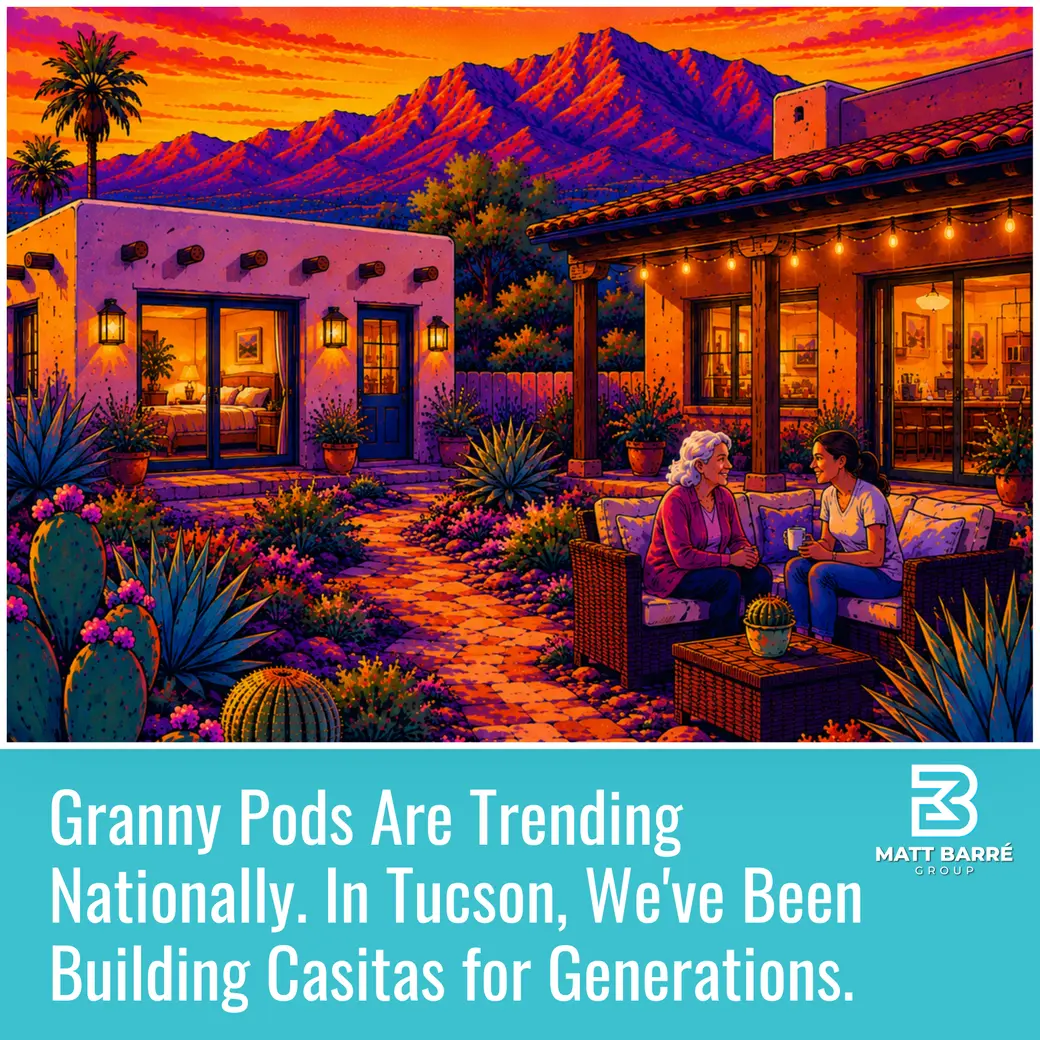
Granny Pods Are Trending Nationally. In Tucson, We've Been Building Casitas for Generations.
If you've searched “assisted living at home” or “granny pod” on Google lately, you are very much not alone. Nationally, searches for “assisted living at home” are up 650% this year, and “granny pods” have climbed 311% right alongside it. That's not a niche curiosity anymore that's a real, measurable shift in how families are thinking about aging parents, adult kids boomeranging back home, and what a house is actually supposed to do for a family.
Here's the thing, though. If you live in Tucson and just discovered what a “granny pod” is from a headline I've got good news. We've basically been doing this for generations. We just call it a casita.
What's Actually Driving This Boom
This isn't just a cute housing trend. It's economics. Jason Waugh, president of Coldwell Banker Affiliates, said back in February that he's seeing a real influx of granny pod requests as families try to make the math work, driven by mortgage rates, tight housing inventory, and the plain fact that traditional senior care has gotten brutally expensive.
And the numbers back him up. The national median for assisted living now runs about $70,800 a year. A private nursing home room? $127,750 a year. Compare that to a backyard casita, which typically runs $85,000 to $125,000 to build, as a one-time cost, on land the family already owns, and you can see why families are doing the math twice.
One homeowner I read about was paying around $135 a month on utilities to keep a casita comfortable for an aging parent. Compare that to $5,900 a month for a private assisted living room. That's not a marginal savings. That's a different financial universe.
Who's Actually Doing This
It's not just one type of family, either. I'm seeing empty-nesters bring an aging parent out from a snowbird state so someone's actually keeping an eye on them, without anyone giving up their independence. I'm seeing adult kids move home after a divorce or a layoff, treating the casita as a soft landing instead of a permanent step backward. I'm seeing retired grandparents build the casita for themselves, downsizing into the small unit and handing the main house over to their kids and grandkids, which, if you think about it, solves about four problems at once: proximity, cash flow, help with the grandkids, and nobody feeling like a burden.
None of these are edge cases anymore. They're becoming a normal Tuesday.
Tucson Was Doing This Before It Was Trending
Here's what's fun about this whole conversation from where I sit: Tucson didn't need a national headline to catch on to multigenerational living. Sonoran-style architecture has featured casitas (small, self-contained guest quarters tucked behind the main house) for as long as this city has been building homes. Walk through Barrio Viejo or the older pockets of Sam Hughes and you'll see the bones of this idea everywhere, decades before “ADU” was a term anyone used in a real estate listing.
So when out-of-state buyers ask me, “Can I actually put grandma, or my adult son, or a home office, or a rental in the backyard here?” my answer is almost always "quite possibly". It's usually a much easier possibility than in the market they're moving from.
What the City of Tucson Actually Allows
If you're picturing red tape, take a breath. Tucson is one of the more ADU-friendly cities in the state. Under the Unified Development Code, most single- and two-family lots qualify for one accessory dwelling unit (casita, guest house, granny flat) whatever you want to call it.
The size cap is 1,000 square feet or 10% of your lot size, whichever is smaller, though every qualifying lot supports at least 650 square feet regardless of how small it is. Setbacks are a manageable 5 feet from the side and rear property lines. Parking? Not required. And your casita can be detached, attached, or even a converted garage, whatever fits your lot and your budget.
The one asterisk I always flag: Historic Preservation Zones, Neighborhood Preservation Zones, and HOAs can layer on their own rules, and city approval doesn't override a subdivision's CC&Rs. So if you're eyeing a property specifically for a casita build, that's a conversation we should have before you write an offer, not after.
Where This Makes the Most Sense
Not every lot is created equal for this. If a casita, guest quarters, or a future rental unit is part of your plan, I'm steering clients toward areas with the room to actually build one well: the bigger lots in Catalina Foothills, the newer construction corridors in Vail and Sahuarita where builders are already designing for flexibility, and the older central Tucson neighborhoods (think Sam Hughes, Colonia Solana, and Blenman-Elm) where alley access and generous backyards make an ADU almost expected rather than exceptional.
I'm also seeing this play out both directions. Some families are buying a home specifically because it already has a casita where aging parents move in immediately, no construction required. Others are buying the lot and the potential, then building once they've settled in. Either way, the question “does this property support a second living space?” has become a completely normal part of my buyer consultations. A few years ago, it barely came up.
A Few Questions Worth Asking Before You Buy (Or Build)
If a casita is anywhere in your plans, here's what I actually walk clients through:
- Is the existing structure permitted, or is it an unpermitted guest house someone built a decade ago and never filed paperwork on?
- Does the lot have alley access, which makes a detached unit dramatically cheaper to plumb and wire?
- Is the property inside a Historic Preservation Zone, where design review can add months to a build?
- Does the HOA — if there is one — allow a second dwelling at all, regardless of what the city says?
None of these are dealbreakers on their own. But they're the difference between a six-month project and an eighteen-month one, and I'd rather you know that before escrow closes than after.
The Real Takeaway
Here's the thing I keep coming back to: this national trend isn't really about pods, or backyards, or square footage. It's about families trying to stay close to aging parents, to adult kids getting back on their feet, to each other, without going broke doing it. And it turns out the city built around Sonoran courtyard homes and 350 days of sunshine happens to be really, really good at exactly that.
If you're weighing whether to move a parent closer, considering a multigenerational setup, or just curious whether your dream Tucson property could support a casita down the road, I'd love to talk it through. No pressure, no hard sell — just a conversation about what's actually possible on the ground here. Reach out anytime.
Categories
Recent Posts

GET MORE INFORMATION
Team Leader/Realtor License ID: SA674778000