

Why Tucson Gets a Monsoon Season — And What to Do to Protect Your Home
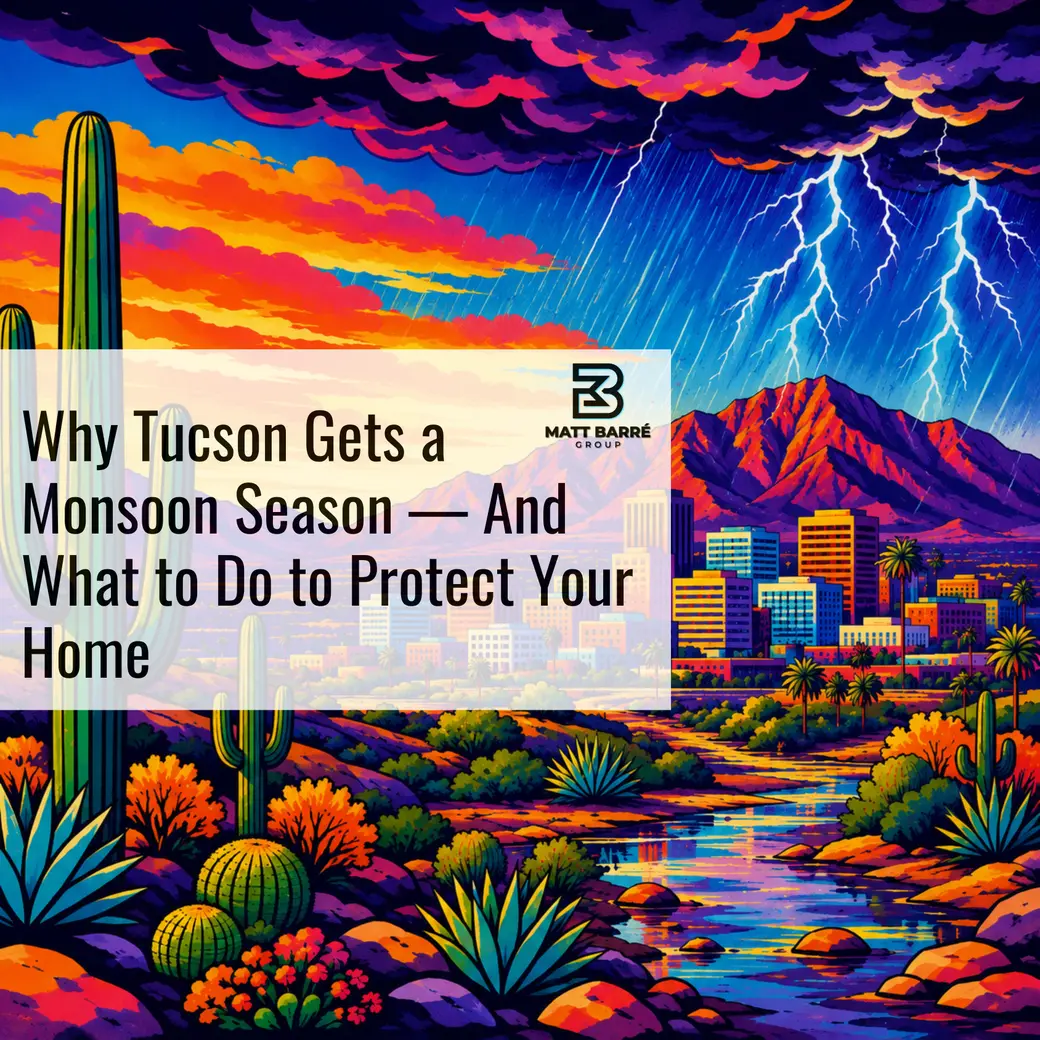
Let's be real for a second. If you've lived in Tucson for more than one summer, you already know the drill: the sky turns that weird greenish-gray, the wind kicks up out of nowhere, and within twenty minutes your patio furniture is in the neighbor's yard. If you're new here, you're probably wondering what on earth is happening to the weather in a desert that supposedly gets 350 days of sunshine a year.
Here's the thing — monsoon season isn't some fluke. It's a real, predictable, scientifically-explainable phenomenon that hits Southern Arizona like clockwork every summer. And once you understand why it happens, prepping your house for it stops feeling like guesswork and starts feeling like common sense. So let's get into both: why Tucson gets a monsoon, and exactly what you should be doing to your home before the first big storm rolls through.
Why Tucson Even Has a Monsoon Season
For most of the year, Tucson's wind comes from the west, which keeps us bone dry. But sometime around mid-to-late June, something shifts. A big dome of high pressure — meteorologists call it the Monsoon Ridge — builds up over the Four Corners region, and it basically reroutes the wind pattern. Instead of dry westerly air, we start pulling in southerly winds loaded with moisture from the Gulf of California, the Gulf of Mexico, and sometimes even the eastern Pacific.
That moisture has to go somewhere, and this is where our geography turns against us — or for us, depending on how you feel about a good storm. Tucson sits in a bowl surrounded by mountain ranges: the Catalinas, the Rincons, the Tucson Mountains, the Santa Ritas. When that humid air runs into those slopes, it gets pushed upward, cools rapidly, and condenses into the towering thunderheads you've probably watched build over the Catalinas on a July afternoon. Add enough heat and instability, and you get the classic monsoon combo: intense wind gusts, dramatic lightning, and rain that can dump an inch in fifteen minutes after months of nothing.
Officially, monsoon season in Tucson runs June 15 through September 30, though most of us know the real action doesn't kick in until mid-July and tends to peak through mid-September. It's dramatic, it's beautiful if you're watching from a safe distance, and it is absolutely something your house needs to be ready for.
What to Do to Protect Your Home
1. Start With the Roof
Your roof takes the brunt of monsoon season, and it's the number one thing I tell clients — buyers and longtime homeowners alike — to check before the season starts. Walk the perimeter of your home and look for lifted or cracked tiles and shingles, especially if your roof has taken a few summers of sun damage already. Desert heat is brutal on roofing materials, and a roof that looks fine in April can have weak spots by July.
Pay close attention to the penetrations — vents, skylights, swamp cooler mounts, satellite dishes — because that's where the vast majority of monsoon leaks start. A little UV-rated sealant around those spots now can save you a very unpleasant surprise on your ceiling later. And if you've got trees close to the house, trim anything within about six feet of the roofline. Monsoon microbursts can push gusts past 40 mph, and a mesquite branch through a window is not the kind of character your home needs.
2. Clear the Gutters and Check Your Grading
A lot of Tucson homes don't have traditional gutters, but if yours does, clear them out now — leaves, dust, and debris collect all year and turn into a dam the second real rain shows up. Just as important, though probably the most overlooked step: check that your yard actually slopes away from your foundation. Desert landscaping and gravel yards can settle unevenly over time, and if water is pooling against your house instead of running off, that's a foundation problem waiting to happen. It's a five-minute check that can save you a five-figure repair.
3. Give Your AC Some Love
I know, I know — the AC feels like a year-round topic in Tucson, not just a monsoon one. But here's why it matters specifically right now: monsoon humidity makes your system work harder than the dry heat ever does, and a unit that's been coasting all summer is more likely to fail right when a storm knocks out power or spikes demand across the grid. Schedule a tune-up before the humidity sets in, and swap your filter more often than you think you need to — in Tucson's dust, monthly isn't excessive, it's just realistic. Also worth a quick look: any exposed ductwork or line sets for cracks or gaps that wind-driven rain could get into.
4. Know Your Plumbing Basics
If you've got a sump pump, test it now, not during the storm. Clear your drains, make sure your sewer cleanout is properly sealed, and — this one surprises people — know exactly where your main water shutoff is. Monsoon storms occasionally bring flash flooding severe enough to back up drainage systems, and knowing where that shutoff is before you need it is the kind of five-second decision that prevents a much longer night.
5. Document Everything Before the Season Starts
This is the step almost nobody does, and it's the one that ends up mattering most if a storm does real damage. Walk around your property and take dated photos — roof, fencing, patio structures, exterior walls, the works. If a microburst takes a tree limb through your carport in August, having a clear before-and-after for insurance makes the claims process infinitely smoother. It costs you fifteen minutes now.
The Common Thread
Here's what I've noticed after years of watching Tucson homeowners go through monsoon season: the people who breeze through it aren't the ones with the newest houses or the biggest budgets. They're the ones who did the boring, unglamorous stuff in June/July — the roof check, the gutter clean-out, the AC tune-up — instead of waiting to react in the middle of a storm. Monsoon season is one of the things that makes Tucson feel alive. The smell of rain on hot asphalt, the lightning shows over the Catalinas, the temperature finally dropping ten degrees after a storm rolls through — it's genuinely one of my favorite parts of living here. It's just a lot more fun to enjoy from the porch when you know your house can handle it.
If you're new to Tucson, thinking about buying here, or just want a second opinion on whether a home you're eyeing is monsoon-ready, I'm always happy to talk it through. That's the kind of thing that's a lot easier to get right before you own the house than after the first big storm rolls in.
Questions about what it's actually like to own a home in Tucson through monsoon season? Drop a comment, send a DM, or reach out directly. I'm always happy to talk shop — and maybe compare notes on the best storm-watching spot in town.
Categories
Recent Posts









GET MORE INFORMATION

Team Leader/Realtor License ID: SA674778000