

AI Is Changing How You Buy and Sell a Home — Here's What That Actually Means in Tucson
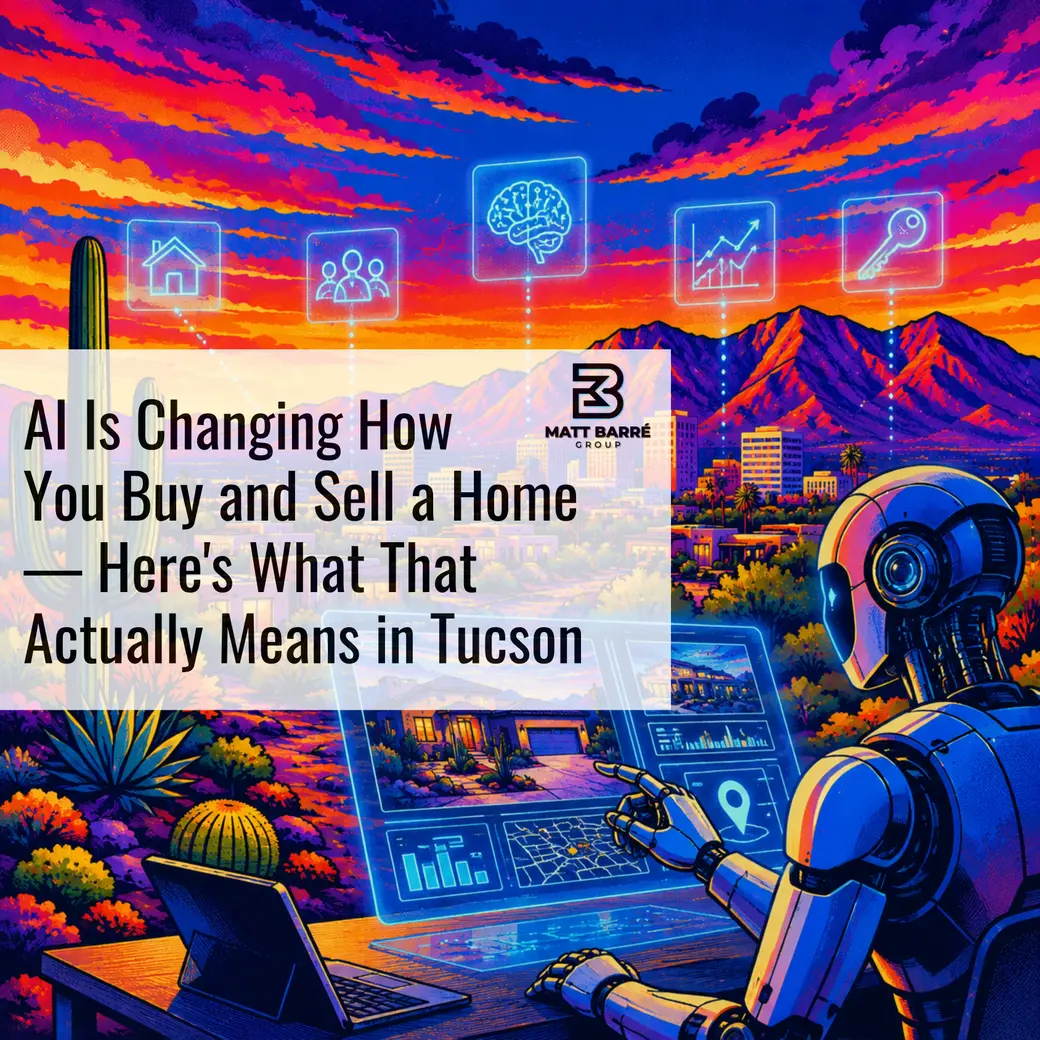
Here's the thing: AI isn't coming for real estate. It's already here, sitting in the front row. More than 60% of buyer-side searches nationally now start through an AI interface instead of a traditional search bar, and 82% of agents say they've built AI into their business in some form. So let's talk about what that actually means — the good, the overhyped, and the stuff that still requires an actual human who knows the difference between Sam Hughes and Catalina Foothills.
Your Home Search Probably Starts With AI Now, Whether You Meant It To or Not
Nearly half of today's buyers — 45%, according to recent survey data — are using some kind of AI tool during their home search. Not necessarily a chatbot with a name and a personality. Sometimes it's just Zillow's plain-English search, where you type "casita with mountain views under $500K near the Rillito" instead of clicking through eight filter checkboxes. Sometimes it's asking ChatGPT to summarize school ratings in Vail versus Marana, or having it explain what "as-is" actually means before you make an offer.
The number that really got my attention: 82% of consumers are now researching properties and neighborhoods with AI tools before they ever pick up the phone to call an agent. Which means by the time I hear from a buyer, they've often already done a first pass — they know roughly what they can afford, they've got three neighborhoods circled, and they've probably already asked an AI whether now is a good time to buy. That's not a threat to what I do. It's actually great. It means our first conversation can start somewhere smarter than "so, what are you looking for."
The Instant Valuation Trap
Here's where I want you to pump the brakes a little. Zillow's Zestimate has genuinely gotten better — its AI model now claims something like a 1.83% median error rate on active listings, which sounds impressive. And for a cookie-cutter subdivision home in a neighborhood with fifteen recent comps, it's often close.
But Tucson isn't always cookie-cutter. An algorithm doesn't know that the historic adobe on your street near the University just got fully re-plumbed and rewired, or that the "comparable" three doors down backs directly onto a wash that floods every monsoon season. It doesn't know that a casita with a separate entrance adds real value in a college town, or that an RV gate is basically a line item out here — not a footnote. I've seen Zestimates miss actual sale price by tens of thousands of dollars on properties with any kind of local quirk, and Southern Arizona has no shortage of those. Use the algorithm as a starting point for a conversation. Just don't sign anything based on it, and definitely don't price a listing off of it alone.
Virtual Staging (and AI Listing Copy) Are Legitimately Great — When They're Honest
This one I'm fully on board with. AI virtual staging can turn an empty room into a furnished one in about 15 seconds, for a fraction — we're talking roughly 95% less — of what physical staging costs. For an investment property in Vail or a vacant listing in Rita Ranch, that's a real win. Buyers can picture the space, sellers don't have to rent furniture for three months, and everybody's happy. Same goes for AI-assisted listing descriptions — they're a legitimately useful first draft for getting the bones of a listing written before I go in and add the details a computer would never think to mention.
The catch: it needs a disclosure, and it needs to be honest. I've seen listing photos where the "staged" living room had proportions that didn't remotely match the actual dimensions of the space. That's not staging, that's a bait and switch, and buyers figure it out the second they walk through the door. Done right, it's a great tool. Done lazily, it torches trust before showing day even happens.
Chatbots Are Basically the New Open House Greeter
A lot of the initial back-and-forth in a home search — "is this still available," "can I see it Saturday," "what's the HOA fee" — is now getting handled by AI chatbots before a human ever steps in. And honestly, that's fine. Nobody's relationship with their agent is built on who answered a scheduling question at 11 PM on a Tuesday. Agents using these tools well are saving four-plus hours a week on average, and some data even shows AI-assisted lead follow-up converting around 40% better than manual follow-up alone. That saved time is going back into things AI genuinely can't do — actually knowing the inventory, walking a property, or sitting across the table during negotiations.
What AI Still Can't Do — And Why That's the Whole Ballgame
Here's the part that matters most if you're buying or selling in Tucson specifically. AI is very good at pattern matching against data it already has. It is not good at knowing that the City Council just approved middle housing zoning that could change what's buildable on the single-family lot down the street from you. It doesn't know which streets flood in a hard monsoon, which HOA in Oro Valley is about to vote on a special assessment, or that the "great deal" three blocks from campus is actually a rental-saturated block that will make financing trickier than it looks on paper.
That local, current, occasionally gossipy knowledge — the stuff that isn't in a dataset — is exactly what determines whether a "good deal" is actually good. AI can tell you what a house is probably worth in general. It can't tell you what it's worth to you, on that street, in this market, right now.
So here's where I land on all of this: use the AI tools. Seriously — Zillow's search, home value estimates, even asking ChatGPT to explain a contingency clause you don't understand. They're useful, they're fast, and they'll make you a sharper buyer or seller walking into any conversation. Just don't mistake "AI told me" for "I know what's actually going on in this market." That second part is still very much a human job — one that involves knowing the neighborhoods, the sellers, the inspectors, and yes, occasionally the wash that floods every August.
If you're thinking about buying or selling in Tucson and want a second opinion that isn't generated by an algorithm, I'd love to talk. I'll even tell you the truth about that Zestimate.
Curious what AI actually gets right, or wrong, about your home's value? Drop a comment, send a DM, or reach out directly. I'll run the numbers myself.
Categories
Recent Posts


GET MORE INFORMATION

Team Leader/Realtor License ID: SA674778000